Picture this. It is a cold Tuesday morning. You stumble to the kitchen for that first cup of joe. The pot is full, but you take a sip and stop. It’s lukewarm. It feels like a total betrayal.
The heating element is the heart of your machine. If it quits, your morning routine flatlines. Is your brewer done for good? I will help you find out.
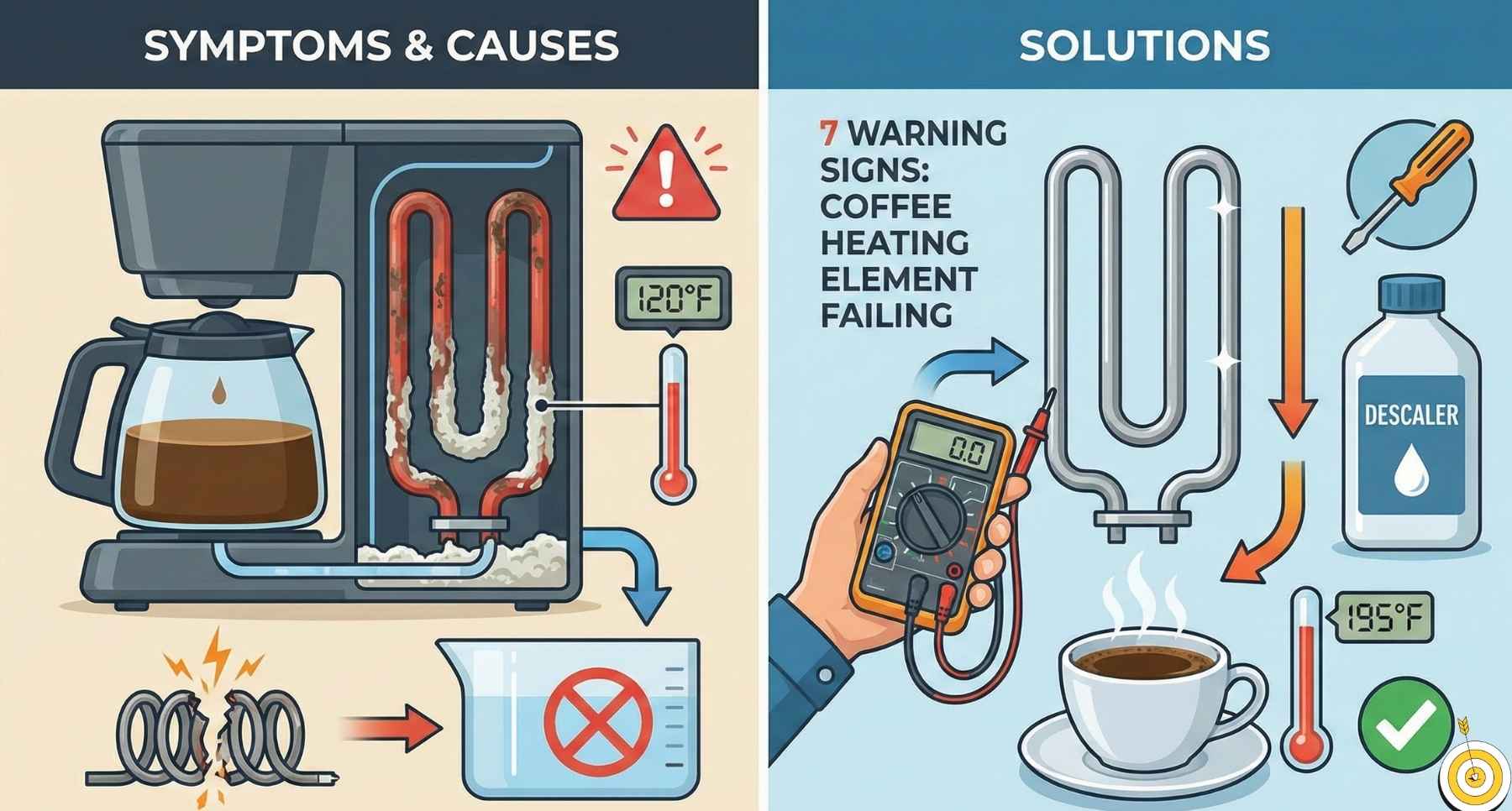
In this post, I’ll walk you through the 7 warning signs your coffee maker heating element is failing, covering symptoms, causes, and solutions. Let’s see if it is time for a quick fix or a funeral for your machine.
The 7 Tell-Tale Signs Your Heating Element is Dying
It rarely happens all at once. Usually, your machine gives you hints before it quits completely. I have seen this happen with a few of my own brewers over the years. Here is what you need to listen and look for.
1. The Coffee is Lukewarm (Not Piping Hot)
This is usually the first red flag. You pour a fresh cup, expecting that 200°F heat, but it is just… warm. It isn’t cold yet, but the flavor is flat.
If you are asking, “why is my coffee maker not heating water like it used to?” it is likely because the element is wearing out. It can no longer reach that high brewing temperature. I hate admitting this, but I have had to microwave a fresh cup just to make it drinkable. That is the ultimate coffee sin.
2. Brewing Takes Forever (Slow Drip)
A healthy machine should brew a full pot in about 5 to 6 minutes. When the element starts to fail, it struggles to flash-boil the water.
Suddenly, your morning routine drags on. You stand there, tapping your foot, waiting 15 minutes for the pot to fill. It is painful to watch. The water drips through slowly because the heat just isn’t intense enough to push it up the tube fast.
3. The Brewing Cycle Stops Halfway
This is incredibly frustrating. You walk away and come back to find the machine off, but the pot is only half full.
The machine basically gave up mid-job. This often happens because the component is overheating, causing the thermal fuse to cut the power for safety. It’s like a runner quitting at mile ten of a marathon.
4. Strange Gurgling or Hissing Noises
We all know the happy sounds of a coffee maker. But there is a difference between a smooth brew and the “gurgle of death.”
If you hear violent hissing or excessive steam, the water isn’t moving smoothly. The heating element might be getting too hot in some spots, boiling the water unevenly. If it sounds like a steam engine in your kitchen, pay attention.
5. A Burning Plastic or Electrical Smell
This is a critical safety warning. If you smell something acrid or plastic-like, stop. This is how to know if coffee maker heating element is broken in a dangerous way.
The element might be shorting out or running dry. If you catch a whiff of this, unplug the machine immediately. Do not try to finish the brew.
6. Your Circuit Breaker Keeps Tripping
I had this happen in an old apartment. I flipped the switch on my brewer, the lights flickered, and pop—the kitchen went dark.
If your machine trips your GFCI outlet the second you turn it on, the heating element likely has an internal short circuit. It is sending electricity where it shouldn’t go.
7. Water Remains in the Reservoir
Drip coffee makers rely on the heating element to create steam pressure. This pressure pushes the water up the tube and over the grounds.
If the element dies completely, it can’t create that pressure. You will hear the machine click on, but the water just sits in the tank. The basket might get a little steam, but the carafe stays dry.
What Causes a Heating Element to Fail?
These components are tough. I have seen some last for a decade. But they aren’t invincible. Usually, it is one of three culprits wearing them down.
Mineral Buildup (The Silent Killer)
If you live in an area with hard water, this is your worst enemy. Over time, minerals like calcium leave deposits inside the metal tube. This is called scale.
Think of it like clogged arteries. This scale layer acts like insulation. The element has to work twice as hard to push heat through that crust to get to the water. Eventually, it overheats and burns itself out. This is exactly what causes coffee maker heating element to fail in most households. If you skip descaling for too long, the damage becomes permanent.
Electrical Surges and Wear
Sometimes, it is just bad luck. A random power spike can zap the internal wire in a split second. But more often, it is just old age.
Every morning, that metal tube heats up and expands. When it turns off, it cools down and contracts. Do this every day for five years, and the internal wire gets tired. It is like bending a paperclip back and forth. Eventually, it just snaps.
Running the Machine Dry
I am guilty of this one. I once hit the “Brew” button before pouring the water in because I was half-asleep.
Turning it on without water is like running a car engine without oil. The element relies on the water to absorb its intense heat. Without water, the temperature spikes instantly. It can fry the component in seconds. If you do this, there is rarely a coming back from it.
How to Test Your Coffee Maker Heating Element
I remember staring at my dead coffee maker, wondering if I should call a pro. No engineering degree is required for this. Being an electrician is not necessary either. All you really need is one specific tool to know for sure.
Safety First (Unplug Everything)
Before we touch anything, listen to me. Water and electricity are a bad mix. I learned this the hard way with a toaster once—don’t ask.
Ensure the machine is cool and disconnected. Unplug it from the wall. Seriously, double-check. You do not want to work on a live appliance.
Using a Multimeter for a Continuity Test
This is the moment of truth. To figure out how to test coffee maker heating element health, you need a multimeter. I grabbed a cheap one from my local hardware store years ago. It works perfectly for this multimeter continuity test.
Here is what I do:
- Open it up: Flip the machine over. You will likely need a screwdriver to take off the bottom plate. Keep track of those screws! I usually put them in a small cup so they don’t roll away.
- Find the part: Look inside. You will see a horseshoe-shaped metal tube. That is your target.
- Connect the probes: Set your multimeter to the continuity setting (the one that looks like a sound wave). Touch the red and black probes to the two metal terminals on the tube.
The Verdict:
- Alive: If the multimeter beeps or shows numbers, you are good. The circuit is complete.
- Dead: If it stays silent or reads “OL” (Open Loop), I have bad news. The internal wire is broken. It is dead.
Solutions: Fix It or Trash It?
This is the money question. Is it worth saving your trusted brewer? Or should you just upgrade? I have stood in the aisle at the store, debating this exact thing. Let’s look at the numbers.
Can the Heating Element Be Repaired?
I hate to be the bearer of bad news. If you are asking, “can coffee maker heating element be repaired?” the answer is no.
You cannot simply patch the internal wire. It gets way too hot. Any tape or solder would melt instantly. You have to replace the entire metal unit.
This is the only real answer for how to fix coffee maker not heating issues. But here is the hard truth. For a basic $30 drip machine, the replacement part often costs more than a brand-new unit. It hurts my wallet just thinking about it.
Is It Worth Fixing? (The Cost Analysis)
This comes down to simple math. Is it worth fixing coffee maker heating element failure? It depends entirely on what sits on your counter.
- High-End Models (like Moccamaster or Breville): Yes. These machines cost over $300. Spending $40 on a new part is a bargain. I would fix mine in a heartbeat to keep it running for another decade.
- Standard Models (like Mr. Coffee or Black+Decker): Probably not. If you paid $25 for it, do not spend $30 on a part plus shipping. Take this as a sign. Use it as an excuse to treat yourself to an upgrade.
Quick DIY Fixes Before You Give Up
Wait! Before you toss it in the trash bin, try these last-ditch efforts. Sometimes the element is fine, but something else is in the way.
- Deep Descale: Run a strong vinegar mix through it. Heavy scale might just be blocking the heat.
- Check for Loose Wires: A wire might have just wiggled loose from the vibration. Open the bottom and push them back in.
- Reset the Thermal Fuse: Remember that safety switch I mentioned? It might have just tripped. If you can find it, a simple reset might bring your brewer back from the dead.
Conclusion
So, there you have it. If you have a standard drip machine and the heating element is gone, it is likely the end of the road.
I know it hurts to throw things away. I hate adding to the landfill. But spending more on parts than a new brewer costs just makes no sense.
A failing machine is a sad way to start a Tuesday. You stand there, mug in hand, waiting for magic that never happens. Instead, you get tepid bean water. You deserve better than that. You deserve piping hot coffee.
If your test confirmed the part is dead, treat yourself to an upgrade. If you are looking for something that actually lasts, check out my latest guide on durable coffee makers. Let’s get your morning routine back on track.
Frequently Asked Questions
1. How do I know if my coffee maker heating element is bad?
Use a tool called a multimeter. Touch the probes to the metal tips. If it beeps, it is good. If it stays silent, the part is dead and needs a swap.
2. Can I repair the heating element myself?
No, you cannot fix the wire inside. It is sealed shut. You must replace the whole metal part. For cheap units, it is best to just buy a new brewer.
3. What causes the element to fail?
Hard water scale is likely the cause. It coats the metal tube. This makes it get too hot and break. Clean your machine often with vinegar to help it last.
4. Is it safe to use a coffee maker if the element is failing?
No, do not use it. It can cause a fire or shock you. If you smell burning plastic, unplug it now. It is not safe to keep using it to brew.
5. Is it worth fixing a cheap coffee maker?
Parts cost up to $40. If your maker was cheap, do not fix it. Buy a new one instead. It saves cash. Only fix expensive brands like Breville or Moccamaster.