HEPA vs. True HEPA: Don’t Let Tricky Labels Ruin Your Air Quality
Clean air is a must, whether you work in a humid Florida workshop or relax in a dusty living room. Breathing safe, fresh air is a big deal. Let’s look at HEPA vs. True HEPA: What is the Real Difference? I want to share the honest facts so you can pick better and live smarter.
The Day I Realized My “HEPA” Filter Was Lying to Me
Let me tell you, breathing clean air is serious business. It really hurts when you find out a clever box label tricked you.
It all started on a horribly hot road trip last July. I had just bought my new sedan. My kid got sick in the back seat. It was bad. The sour smell sank deep into the fabric, and if you’ve ever had to figure out how to get rid of stubborn smells in your car interior, you know it just lingers there for days.
That car disaster sparked a mild obsession with finding ways to improve indoor air quality. Fresh air was a must in my home, especially with the thick, dry dust that constantly drifts around Alabama. To tackle the problem, I went out and bought an air purifier to clear the room.
The box just said “HEPA” on the front. I brought it home and plugged it in. It hummed along nicely. But a week went by, and the air still felt heavy. I bake sourdough bread on the weekends. The fine white flour dust was still settling thickly all over my kitchen counters. The machine did nothing to stop it.
I felt cheated. That is exactly when I started digging into HEPA vs True HEPA filters. I quickly learned they are absolutely not the same thing.

What Does True HEPA Mean, Anyway?
A true HEPA filter isn’t just a fancy marketing word slapped on a cardboard box. It is a strict, undeniable scientific standard.
- The real definition: I sat at my kitchen table one Tuesday morning and finally Googled, “what does true HEPA mean?” The HEPA meaning is actually pretty simple. It stands for High-Efficiency Particulate Air.
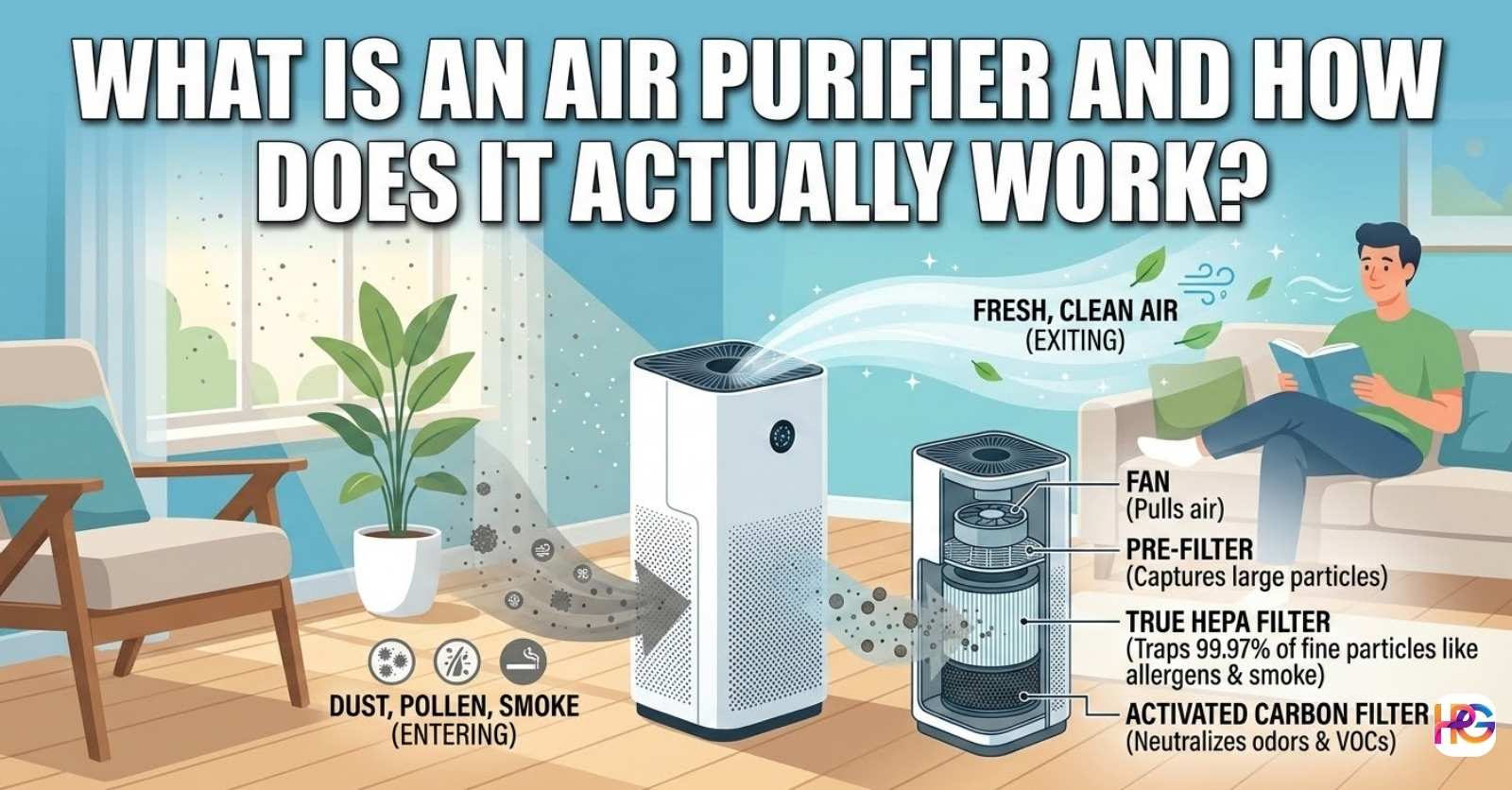
- How it works: Think of a HEPA filter like a wildly tangled spider web. It uses a thick, random mat of tiny fiberglass fibers. When your machine pushes dirty air through it, this web traps microscopic pollutants. The bad stuff gets stuck, and only clean air flows out.
The Strict HEPA Filter Standards
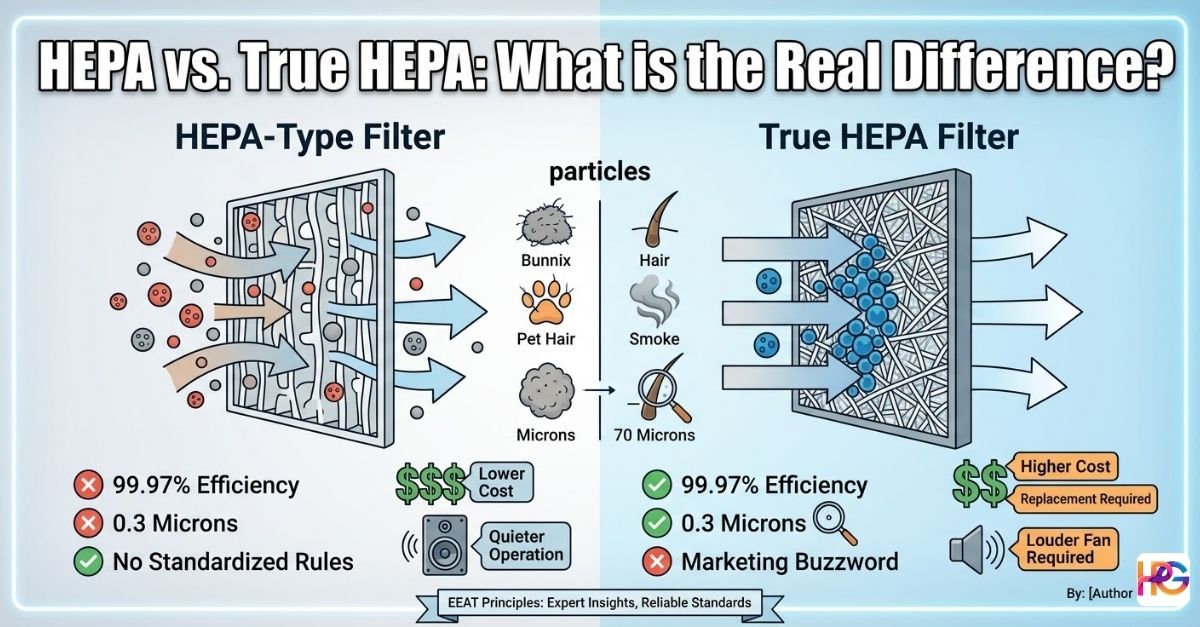
- The magic numbers: A company cannot just call any cheap piece of paper “True HEPA.” It must pass very strict HEPA filter standards. To earn that trusted badge, the filter must capture 99.97% of particles down to 0.3 microns in size.
- What that looks like: Let me give you a visual. Pluck a single hair from your head. That hair is about 70 microns thick. A 0.3-micron particle is so tiny you cannot even see it without a microscope. This filter catches the invisible garbage in your house. It grabs nasty smoke. It stops yellow spring pollen. It traps that fine, floating dust that makes your throat itch when you first wake up.
HEPA Type Filter Meaning: The Marketing Illusion
Here is where the appliance marketing teams try to pull a fast one on all of us. They use vague wording to make a quick sale, and it works perfectly.
- The visual illusion: I remember pulling that useless filter out of my machine on a lazy Sunday afternoon. I held it up under the bright kitchen lights. It looked totally real. When you search for the true HEPA type filter meaning, you find a clever trick. The filter has those crisp, white paper pleats. It looks exactly like the real deal. But I felt a bit foolish staring at it. It was just a very good knockoff.
- The harsh reality: If a glossy cardboard box just prints “HEPA” or “HEPA-type” in bold letters, it means almost nothing. There is no strict law backing that label up. There is no legal, standardized testing required. They just borrow a trusted medical term to sell cheap plastic fans.
- The massive drop-off: This is where you really see the core hepa filter differences. These cheaper filters do not perform well. They might only capture 99% of the dust. Some only catch about 85%. Worse, they usually only stop particles down to 2 microns in size. That leaves a ton of microscopic garbage just floating around your living room while you watch TV. You end up breathing in the exact stuff you paid to get rid of.
True HEPA vs HEPA: The Head-to-Head Breakdown
Let’s put these two side by side. We need to see exactly what you get when you buy a replacement.
- Efficiency showdown: In the daily battle of true hepa vs hepa type, we have a clear winner. True HEPA guarantees it catches 99.97% of dust at 0.3 microns. A standard “HEPA” filter is just a wild card. I hate wild cards when it comes to my lungs. You just plug it in and hope it works.
- Airflow and noise: “HEPA-type” filters use loose fibers. Air flows through them very fast. They run very quiet. But a true hepa filter vs hepa filter matchup shows a big change. True HEPA needs a strong, loud fan motor. It has to push air hard through that thick mat. My real unit is definitely louder on high speed. It sounds like a strong gust of wind in the room. But that loud hum means it is actually doing the hard work.
- The cost factor: Let’s talk about the money. True HEPA filters cost more to buy. They also cost more to swap out. I frowned a bit when I paid for my first real replacement. But buying a cheap basic filter ruins your indoor air quality. You save twenty bucks today, but you just keep breathing the same dirty air.
What About Medical Grade HEPA and H13?
You might see “H13” floating around online. It makes you wonder if you really need hospital-level clean air in your house.
- The next level: Late one evening, I was scrolling on my phone on the couch. I kept seeing the term medical grade HEPA. I also saw the label filter hepa h13. What does that mean? It is the next level of clean. These filters grab 99.95% of bad stuff. They catch things down to an incredibly tiny 0.1 microns.
- Comparing the tiers: Let us look at a true hepa filter vs hepa 13. The H13 rating is a big step up from standard True HEPA. You usually find H13 filters inside real hospitals. They are also used in spotless scientific cleanrooms. It is very serious gear.
Is True HEPA Necessary for You?
- The direct verdict: So, I had to sit back and ask, is true hepa necessary? Let me answer that directly. Maybe you just want to grab flying dog hair. Maybe you just want to catch huge dust bunnies rolling across the floor. If so, a basic filter might work fine. You will save a little money.
- Who really needs it: But life is not always that simple. If you need to manage asthma and morning allergies, getting real help from a True HEPA filter is an absolute must. If you live in a highly polluted area, True HEPA is completely non-negotiable. It truly changes how your chest feels when you take a deep breath.
How to Pick the Best HEPA Filter for Home Use
Let’s cut through all the messy confusion. You just want to keep your space breathing easy. Here is exactly what you need to do.
- Read the fine print: Always ignore the big shiny letters on the front of the box. Marketing teams love to stretch the truth. You have to flip the box over. Look closely at the small text on the back. You need to see the exact claim: 99.97% at 0.3 microns. Spotting that tiny number is the only way to settle the hepa filter vs true hepa debate for yourself.
- Check the tight seals: A great filter is completely useless inside a cheap machine. When I unboxed my good unit, I ran my fingers along the inside edges. It had thick, tight rubber gaskets. These rubber seals lock the filter down. If a machine just slides the filter into hard plastic slots, dirty air will just sneak right around the edges. It defeats the whole purpose.
- The maintenance habit: You have to build a strict new habit. The tap water in my area is very hard. Because of that, I have to religiously descale my electric coffee machines every two months. It is an annoying chore, but I do it so my machine survives. You need that exact same discipline here. An air purifier only works if you actually know when to change the filter on schedule. A clogged, dirty True HEPA filter is actually much worse than a clean HEPA-type filter.
- The core philosophy: At the end of the day, finding the best hepa filter for home use just takes a little patience. Take a few extra minutes to read the boring spec sheet. When you know the facts, you pick better. And when you pick better, you live smarter. Your lungs will definitely thank you.
At a Glance: HEPA vs. True HEPA Comparison
Sometimes it helps to see the cold, hard numbers side-by-side. It keeps the marketing fluff out of the way so you can make a smart choice for your home.
| Feature | HEPA-Type Filter | True HEPA Filter | Medical Grade (H13) |
| Efficiency | 85% to 99% | 99.97% | 99.95% to 99.99% |
| Particle Size | 2.0 microns or larger | 0.3 microns | 0.1 microns |
| Best For | Basic household dust | Allergies and asthma | Smoke and tiny viruses |
| Noise Level | Very quiet | Moderate to loud hum | Usually quite loud |
| Filter Cost | Very cheap | Mid-range | High price |
Pro Tip: If you are a sourdough baker like me, go for the True HEPA. It is the only way to catch that super fine white flour dust before it coats every inch of your kitchen.
Frequently Asked Questions
What is the main difference between True HEPA and HEPA-type?
True HEPA must catch 99.97% of tiny dust. HEPA-type has no set rules. It often misses the smallest particles that can make you cough or sneeze.
Is a True HEPA filter really necessary for my home?
If you have bad allergies, yes. It traps smoke and pollen much better. You pay a bit more, but your home air will feel much fresher and cleaner.
Can a HEPA filter remove pet hair and sourdough flour?
Yes, it is great for fine dust. It traps tiny bits that basic filters miss. This keeps your kitchen clean even after a long day of bread baking.
What does the H13 label mean on some air filters?
H13 means medical grade. This level of filtration goes beyond True HEPA, capturing almost every tiny particle in the air. It makes it a top choice for maintaining a very clean home.
How do I know if my filter is a real True HEPA?
Look at the back of the box. It must say it traps 99.97% of bits at 0.3 microns. If it does not say that, it is likely just a HEPA-type filter.